Showing posts with label travel. Show all posts

Friday, November 18, 2011

Volcano Eruption Sparks Tourism

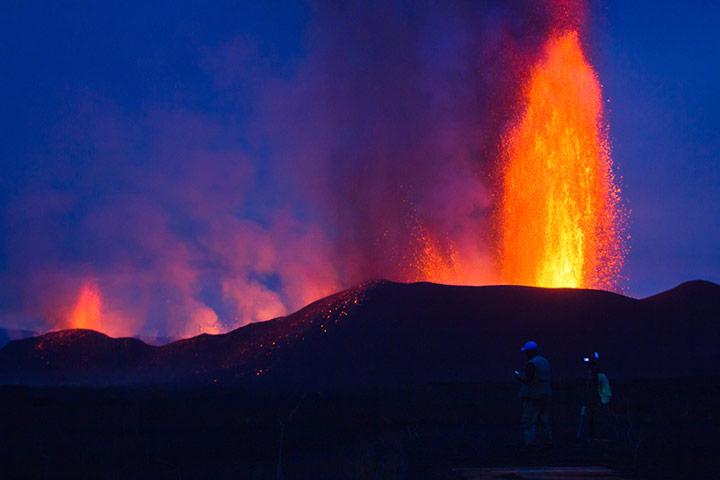
Mount Nyamuragira 
Mail and Guardian: Its status as the battleground in "Africa's world war", and possibly the worst place on Earth to be a woman, makes it arguably the world's most counterintuitive holiday destination.

Yet tourism in the Democratic Republic of Congo's ravaged east is doubling by the year as intrepid travellers set out to witness its natural wonders.

From a standing start of zero in 2008, when war was still raging, Virunga National Park's visitor numbers climbed to 550 in 2009, then 1 800 in 2010 with an expected 3 800 for 2011. As a result, this year the oldest national park in Africa expects to raise more than $1-million.

Among the attractions on offer are an overnight trek to the eruption of the Mount Nyamuragira volcano and tracking through forests to glimpse critically endangered mountain gorillas.

In a sign of growing confidence, Virunga is also due to open its first tourist lodge on January 1, with guests paying $200 a night in 12 bungalows boasting lava-rock walls and thatched roofs.

"Clearly it's not Spain we're trying to sell," said Cai Tjeenk Willink, the park's business development officer. "The good thing is we have high-quality attractions here: the mountain gorillas, the active volcanos, safaris with elephants, lions and leopards, the lake, a lowland forest and one of the highest mountain ranges in Africa. We have a lot to offer."

Willink said that most visitors were from Belgium, the former colonial power, and about one in 10 is British.

The Nyamuragira volcano began erupting on November 6 and has several lava fountains spewing up to 200m into the air, with lava flowing slowly north into an uninhabited area of the park.

The park, a Unesco world heritage site, has set up a tented camp in a safe area close to Nyamulagira, where visitors can stay overnight.

Thursday, November 17, 2011

New Website Offers Deals on Last Minute Getaways

MSNBC: First came LivingSocial Escapes, which offers customers discount vacation packages.

Now comes LivingSocial Instant Escapes, launched Thursday, which offers customers last-minute travel deals up to 55 percent off.

Doug Miller, senior vice president for LivingSocial’s new business initiatives, told msnbc.com that he’s seen a lot of interest from customers in last-minute travel. While most LivingSocial Escapes packages can be booked several months out, Instant Escapes deals are aimed at travelers who don’t have plans for the upcoming weekend. “Our focus is on creating demand,” he said.

Customers can find these last-minute deals on the current LivingSocial Escapes website or mobile app or sign up to receive weekly e-mails. New deals will be posted on Wednesdays, focusing on destinations within driving distance and are good for either that Thursday, Friday or Saturday night. Most deals are one-night stays, Miller said.

The first Instant Escapes deals include:

- $139 per night at the Larkspur Hotel in San Francisco, which also includes a $15 credit to the on-site Bar 1915 and a $75 credit to rent a luxury car;

- $265 per night for a room at The Hudson Hotel in the Hell’s Kitchen area of New York City, as well as free WiFi, late check-out and continental breakfast for two; and

- $84 per night at Washington, D.C.’s Hotel Madison with a complimentary room upgrade and late check-out.

Since launching a year ago this month, LivingSocial Escapes has sold nearly 600,000 room nights at more than 800 different properties around the world. It was quickly followed by Groupon Getaways, which launched over the summer.

Carroll Rheem, director of research for PhoCusWright, said the challenge for deal sites is to drive incremental bookings, not undercut the price for a customer who was already planning a trip. She sees last-minute escapes as a niche market.

“If you’re kind of bored for the weekend, that’s a very different experience than ‘I know I was going to take a trip,’” she said.

AAA: Thanksgiving Travel Up 4% Over 2010

Click on Detroit: More Americans are hitting the road this Thanksgiving holiday, despite higher gas prices, according to the motorist group AAA.

The American Automobile Association projects 42.5 million Americans will travel at least 50 miles during the Thanksgiving weekend, an increase of 4 percent from the 40.9 million people who traveled last year.

But gas prices are also up, making the drive more expensive this year. The nationwide average price of unleaded gasoline was $3.39 per gallon on Thursday, compared with an average of $2.88 a year ago.

The high cost of gas might be why travel was flat for Memorial Day and actually decreased, compared to last year, during Independence Day and Labor Day. But the Americans who have been staying home to save money are shrugging off their financial concerns for Turkey Day, according to AAA.

"Driving AAA's projected increase in the number of Thanksgiving travelers is pent-up demand from Americans who may have foregone holiday travel the last three years," said Bill Sutherland, vice president of AAA Travel Services, in a prepared statement.

"As consumers weigh the fear of economic uncertainty and the desire to create lasting family memories this holiday, more Americans are expected to choose family and friends over frugality.

Driving will be the dominant mode of transportation during Thanksgiving, while forecasts for air travel are mixed. AAA is expecting air travel to increase by nearly 2 percent, but the Air Transport Association of America is projecting a 2 percent decrease.

AAA defines the Thanksgiving weekend as the period from Nov. 23 to Nov. 27.

New York Tops December Hotel Searches

Rockefeller Center Christmas Tree
USA Today: Where are travelers most searching for hotels this December? New York tops the list, according to Kayak.com's analysis of two years of hotel-search data.

The Big Apple, after all, does a fantastic job of decking itself out for the holidays. And each year, tourists from the Tri-State area - and around the world - flock to the city to soak up the atmosphere.
Last week, workers were busy hanging gigantic snowflakes from wires high above Fifth Avenue. Visitors also love to photograph the spectacular Rockefeller Center Christmas tree, which will be lit this year on Nov. 30, and take in other festive sights - including hotels adorned with decorations.

So what about the four other cities that made Kayak.com's Top 5 list? They're all warm-weather destinations.
It makes you wonder if Northeast residents rushed to book December trips after the freak, Oct. 29 snowstorm pounded the region and left millions without power for days.

The full Top 5 from Kayak:
·         New York
·         Las Vegas
·         Orlando
·         Cancun
·         Miami

The Top 5 cities that experienced the biggest increases in hotel search volume for December travel on a year-over-year basis:
·         Miami
·         San Francisco
·         New Orleans
·         Fort Lauderdale
·         New York

On the flip side, Kayak.com also looked at cities that fell out of favor this year compared to 2010.
Deal seekers may want to scan this list of Top 8 cities where hotel search volume decreased the most on a year-over-year basis because they could have better luck in these destinations finding hotel bargains in December:

·         Barcelona
·         Los Angeles
·         San Diego
·         Boston
·         Nassau, Bahamas
·         Punta Cana, Dominican Republic
·         San Juan, Puerto Rico
·         Chicago

Innovative Travel Companies Recognized

MSNBC: Travelers face no shortage of challenges, from finding the right hotel to making the most of their vacation to knowing which restaurant recommendation to trust.

On Tuesday, 32 companies looking to make the travel experience better presented their products at the Travel Innovation Summit at this year’s PhoCusWright conference before their peers in the travel industry, a circle of critics and a panel of judges.

Among this year's winners, announced Wednesday:

GroundLink: a global, private car service that can be booked online or via mobile.

Gtrot: a website that provides travelers with targeted content such as deals or things to do in a specific city, based on their friend's social media activity through sites such as Facebook or Foursquare.

Evature: Eva, its Expert Virtual Agent, is designed to understand travel requests submitted in natural language, also known as free text.

Hipmunk: offers a flight and hotel search that now integrates with a traveler's calendar and features a heatmap for cities throughout the world based on, for example, the density of shopping or nightlife in a particular neighborhood.

ReviewPro: a customer intelligence tool that hotels can use to profit from the social web and manage their online reputation.

The judges also gave runner-up nods to two companies: Tru, a global mobile carrier, and TripLingo, a language-learning app that includes, among other things, a Slang Slider that helps travelers find the best translation.

“Travel is still very open to innovation,” Gregg Brockway, co-founder of TripIt and one of this year’s judges, told msnbc.com “I think we saw some companies that are answering really interesting problems.”

TSA Blasted for Being "Bloated, Inefficient"

CNN: Ten years after its formation, the Transportation Security Administration on Wednesday got the type of birthday card no one wants to receive -- a blistering report from Republican lawmakers who said the agency is "bloated" and "inefficient" and has done little, if anything, to improve aviation security.

Rep. John Mica, R-Florida, a longtime critic who has fought to privatize TSA screening jobs, said Congress never intended the agency it created in November 2001 to "mushroom" into a workforce of 65,000 employees, "top heavy" with bureaucrats.

"I can tell you, in our wildest dreams ... no one ever envisioned 4,000 administrative personnel in Washington, D.C., making on average ... almost $104,000, and then nearly another 10,000 out in the field," Mica said.

But the most scathing comment came from Rep. Paul Broun, R-Georgia.

"Americans have spent nearly $60 billion funding TSA and they are no safer today than they were before 9/11," Broun said.

Pressed on the accuracy of that statement, Broun and Mica said the TSA has never stopped a terrorist attack, and gave credit to private citizens or others for terrorist plots disrupted thus far.

"Unfortunately, the focus has been diverted from security ... into managing a huge bureaucracy," Mica said.

Broun concurred. "We must focus on identifying terrorists and stopping them instead of patting down grandma and children. And we must stop worrying about political correctness," he said. "TSA needs to put their resources into intelligence and technologies that can be more effective when it comes to catching highly elusive and dangerous terrorists."

The lawmakers said they are preparing legislation to reform the TSA.

A TSA spokesman called the GOP report "an unfortunate disservice to the dedicated men and women of TSA who are on the front lines every day protecting the traveling public."

The country's aviation system is "safer, stronger, and more secure than it was 10 years ago," spokesman Greg Soule said. The agency has screened more than 5 billion passengers over the past decade, he said, and has prevented more than 1,100 guns from being brought onto passenger planes this year alone.

Mica and Braun released the GOP report at a news conference held in the main concourse of Reagan-Washington National Airport. Their remarks criticizing the state of aviation security were amplified over a loudspeaker, and drew sidelong glances from passengers headed to airport checkpoints.

One day earlier, TSA Administrator John Pistole stood in the same location to discuss holiday travel preparations, touting advancements in screening technology and saying passengers are happy with changes that have reduced the number of pat downs of children.

The report released Wednesday was prepared by Republican staffers on House Transportation and Oversight committees. It is largely a compendium of earlier critical reports of the TSA, looking at its deployment of failed technology, such as puffer machines; the failure to interdict terrorists, such as 2001 "shoe bomber" Richard Reid and 2009 "underwear bomber" Umar Farouk AbdulMutallab"; and the lack of card readers for the 1.8 million ID cards issued to transportation workers.

The report says the agency has grown nearly four-fold since its inception, from 16,500 workers to more than 65,000, while commercial passenger traffic has increased less than 12 percent.

But a TSA spokesman said the agency had approximately 56,000 security officers in 2002, the year it started screening, and has approximately 52,000 today.

The report by the Republicans contains 11 recommendations, saying the TSA must act with greater independence from the Department of Homeland Security, and the administrator's stature must be elevated. The TSA has become "lost" in the Homeland Security bureaucracy, Mica said.

It also calls on the agency to contract out more screening jobs to private industry. Currently, 16 airports, including San Francisco International, have "opted out" of federal airport screening and use private screeners under what is known as the Screening Partnership Program. The screeners wear the same uniforms, use the same technology and follow the same procedures.

Mica advocates the continued privatization of airport screening jobs, but administrator Pistole has been less supportive, at one point saying he would expand the program only if there was a clear advantage to doing so.

In other TSA news, a travel industry group Wednesday said the agency's screening procedures remain "inefficient and frustrating" for travelers.

The U.S. Travel Association released the results of an online survey it conducted last month of about 600 people.

According to the survey, "four of the top five air traveler frustrations relate to the checkpoint process," including the top frustration: "People who bring too many carry-on bags through the security checkpoint." But five of the 11 options on the survey pertained directly to TSA checkpoints, and the remaining options did not include some common irritants, such as excess baggage fees.

The survey says 66.2 percent of air travelers are "somewhat or very satisfied" with the TSA's overall performance as it relates to security, 21.2 percent are neutral, and 12.5 percent are "somewhat or very dissatisfied."

But frequent air travelers are less happy, with 54.6 percent "somewhat or very satisfied."

The group said that despite the TSA's new initiatives to improve passenger screening, an "overwhelming majority" have not recognized any improvements in checkpoint efficiency when compared to the previous year. It said 81.8 percent plan to arrive at the airport the same amount of time before a flight as they did last year.

The survey has a margin of error of plus or minus 4 percent.

The TSA said it was pleased to see the vast majority of travelers polled believe the agency is moving in the right direction, and said checkpoint screening has gotten speedier, taking less than 20 minutes for more than 99 percent of passengers last year.

"The increased number of carry-on bags impacts our ability to further reduce wait times, but not the level of security we provide, which remains our priority," the agency said.
Sunday, August 21, 2011

Plans for Bering Strait Tunnel Gains Support

MSNBC: A train could someday make a journey from New York City to London if a plan to build a 65-mile tunnel between North America and Asia comes to pass.

The Times newspaper in the U.K. said that idea to construct a $60 billion tunnel under the Bering Strait was this week backed by some of President Dmitry Medvedev’s top officials.

The paper described the idea as "the greatest railway project of all time."

The tunnel would mean Russian territory would meet U.S. jurisdiction underneath the islands of Big Diomede, which is Russian, and Little Diomede, which is American. One problem might be that there is no rail line to Alaska's west coast.

The Times named one of the officials supporting the plan as Aleksandr Levinthal, the deputy federal representative for the Russian Far East.

The idea dates back more than a century; the ill-fated tsar, Nicholas II, approved similar tunnel plans twice, but World War I and then the Russian revolution intervened.

Cheaper, faster than container ships
The paper said supporters of the idea believe it would be a cheaper, faster and safer way to move goods around the world than container ships, estimating it could carry about 3 percent of global freight and make about $7 billion a year. Levinthal and several other Moscow officials took part in a conference in Yakutsk in eastern Russia that discussed how to improve infrastructure in the region, the Times said.

A 500-mile rail line linking Yakutsk to the Trans-Siberian railway is currently being built and Russia plans to lay more track to connect mineral-rich areas to freight lines. "We should see advanced development of road and rail infrastructure here [in the Russian Far East] and improvement in the investment climate in Russia as a key aim," Levinthal said, according to The Times.

The tunnel would be the first dry connection between the two continents since a land bridge 21,000 years ago. Stephen Dalziel, head of the Russo-British Chamber of Commerce, sounded a note of caution, suggesting U.K. investors, at least, were unlikely to put money into the tunnel project until it actually began.

"It would be a great idea, if it worked," he said. The idea was discussed in 2007 at a conference in Moscow called "Megaprojects of Russia's East ."

George Koumal, president of the Interhemispheric Bering Strait Tunnel and Railroad Group, called on governments to back the tunnel at the meeting. He suggested it would bring the two people's closer together, noting the current lack of links. "There are very few [Russian] people who have stood on the beach in Alaska," he said. "Seemingly you can stretch out your hand and touch Mother Russia."

However, at that time, a Russian economics ministry official threw cold water on the idea, wondering who would pay for the project.

Saturday, June 4, 2011

Kayak Rated Fastest Travel Web Site

MSNBC: Just a few seconds make the difference between browsing for a plane ticket and buying one, according to travel experts. If you’re addicted to quick clicks, a new 15-month study has ranked the speed of travel companies’ websites – down to a millisecond.

The study, conducted by Compuware Gomez for USA Today, was based on the premise that many consumers will click away from a website if it’s too slow to load or complete a transaction. “Too slow” is not exactly poky. Quoting Forrester Research, the paper says online shoppers expect webpages to load in two seconds or less; 40 percent of shoppers will abandon a page that takes three or more seconds to appear.

“Customers simply don’t want to wait,” Forrester analyst Mike Gualtieri told USA Today. “There is a performance arms race among the travel websites because they know how important this is."

So, who’s winning the war? Kayak ranked as the fastest of all travel sites. With a homepage load time of 1.231 seconds, the booking service beat 45 other online travel agents and all airline and hotel sites.
Among the 12 airlines monitored, the top spots for speediest homepage went to AirTran at an average of 2.065 seconds, followed by Delta, Frontier and Hawaiian, all of which clocked in at under 2.8 seconds. Alaska Airlines was the slowest, at 5.12 seconds, although company spokeswoman Marianne Lindsey said the airline was posting faster times since redesigning its website in April.

On the hotel front, the study looked at 47 booking sites and found that 10 beat the two-second mark. They included Marriott, Best Western, Holiday Inn and Hotels.com, with Marriott and Best Western taking first and second, respectively.